For weeks, the situation surrounding the Daniel Pearl Memorial Lecture at UCLA followed a familiar pattern. A ‘controversial speaker’ (CBS’s Bari Weiss), internal disagreement, and public statements that attempted to downplay how decisions were being made behind the scenes. But thanks to newly released public records, that narrative is no longer sustainable.
The latest batch of emails, obtained through public records requests by the Manhattan Institute and brought into wider public view through reporting from The Washington Free Beacon and coverage involving Jewish News Syndicate, provide a much clearer picture of what actually happened inside UCLA. These records do not simply add context. They directly contradict prior public statements made by UCLA political science professor Margaret Peters, who also serves as the Associate Director of the Burkle Center for International Relations.
Previously, as we noted in our earlier blog post, Peters had already drawn scrutiny after reports indicated she threatened to resign from her leadership role at UCLA’s Burkle Center if journalist Bari Weiss was allowed to deliver the lecture. At the time, that raised legitimate concerns about whether internal pressure was being applied to influence the event. However, Peters publicly stated that she “wasn’t involved in discussions about whether the event would proceed,” suggesting a degree of separation from any decision-making process.
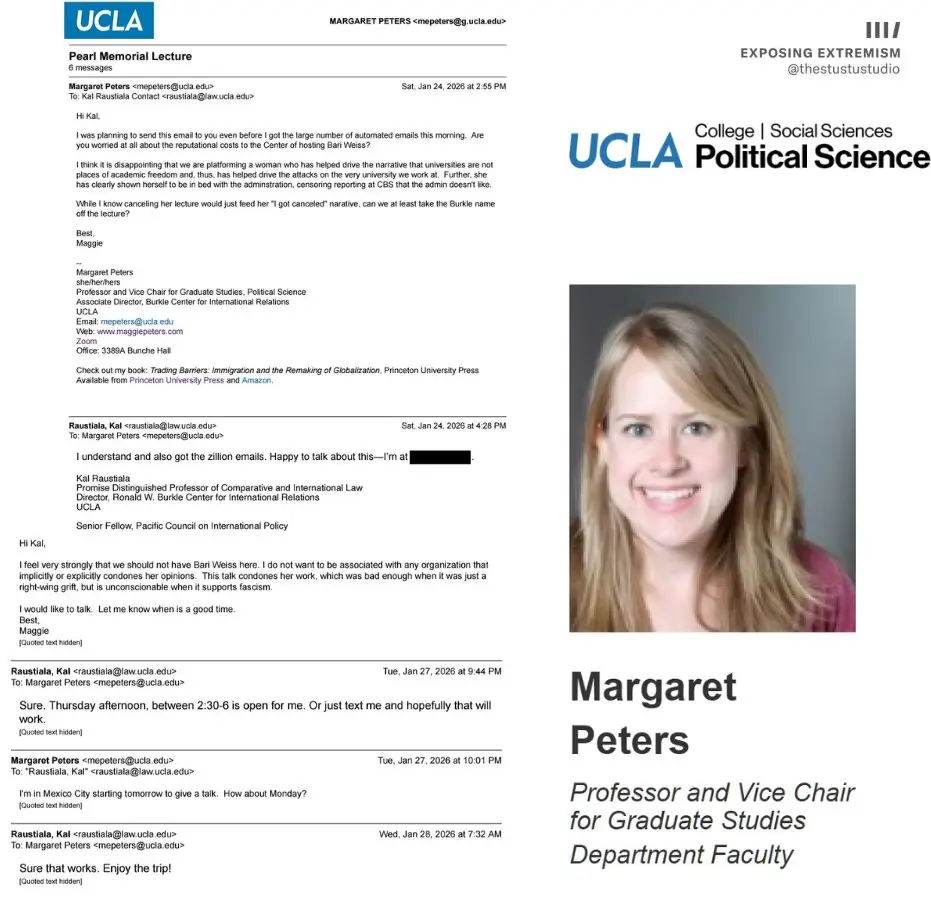
The newly released emails make that claim difficult to reconcile with reality. In her own words, Peters raised concerns directly to UCLA leadership about the “reputational costs” of hosting Weiss. She characterized Weiss as someone who had contributed to “narratives that universities are not places of academic freedom and, thus, has helped drive the attacks on the very university we work at.” In the same correspondence, Peters suggested that while canceling the lecture outright might “just feed her ‘I got canceled’ narrative,” she advocated for the university to remove the Burkle Center’s name from the event. That is not the posture of someone uninvolved, rather it is the exact posture of someone actively engaged in shaping the institution’s response.
Additional outbound emails reinforce that this was not a single passing remark or an isolated concern. Peters communicated a strong personal objection to Weiss’s participation and indicated she did not want to be associated with any organization that, in her view, implicitly supported Weiss’s work. She explicitly asked to discuss the matter further with the director of the Burkle Center, signaling an ongoing effort to influence how the situation would be handled. These communications reflect a sustained level of involvement that stands in clear tension with her public characterization of her role.
It is important to be precise about what this does and does not show. Universities are places where faculty members are expected to have opinions and to express them. Disagreement with a speaker is not unusual, nor is it inappropriate. What raises concern here is the disconnect between private actions and public statements. When a senior academic leader is actively communicating with decision-makers, proposing institutional changes related to an event, and seeking to distance her own center from that event, it is reasonable to describe that as involvement.
From the perspective of institutional accountability, that distinction matters. Public trust in universities depends not only on the decisions they make, but on how transparently those decisions are communicated. When there is a gap between internal activity and external statements, it creates confusion at best and undermines credibility at worst.
The role of outside organizations and journalists in bringing this information forward is also worth noting. Public records laws exist precisely so that the public can better understand how decisions are made within taxpayer-supported institutions. In this case, the Manhattan Institute’s records requests, combined with reporting from the Washington Free Beacon and follow-up coverage from Jewish News Syndicate, helped surface information that would not otherwise have been available. That process is an essential part of ensuring transparency and accountability.
Taken together, the timeline is now clearer. Initial reporting highlighted internal objections and the possibility of resignation. Subsequent public statements attempted to minimize involvement. Now, the underlying communications show that Peters was, in fact, engaging with leadership, raising objections, and proposing specific steps related to Weiss’ lecture. Readers can draw their own conclusions about how to interpret that sequence of events, but the factual record is no longer in dispute.
Our focus is on examining whether institutions and their leaders are living up to the standards they publicly promote. This situation raises straightforward questions about consistency, transparency, and accountability. Moreover, The Burkle Center exists to foster discussion, international dialogue, and serious engagement with complex global issues. Leadership at such a center carries with it a responsibility to model intellectual openness. Disagreement with a speaker’s views is expected in academia, but attempting to prevent those views from being heard at all is something very different.
When public statements do not align with documented internal actions, it is appropriate to ask for clarification. UCLA and Professor Peters now have an opportunity to address those questions directly. Clear explanations, grounded in the full context of the communications, would go a long way toward restoring confidence in how these decisions were handled, then and how they are handled moving forward.