
Smoothie King and the Slippery Slope of Viewpoint-Based Service
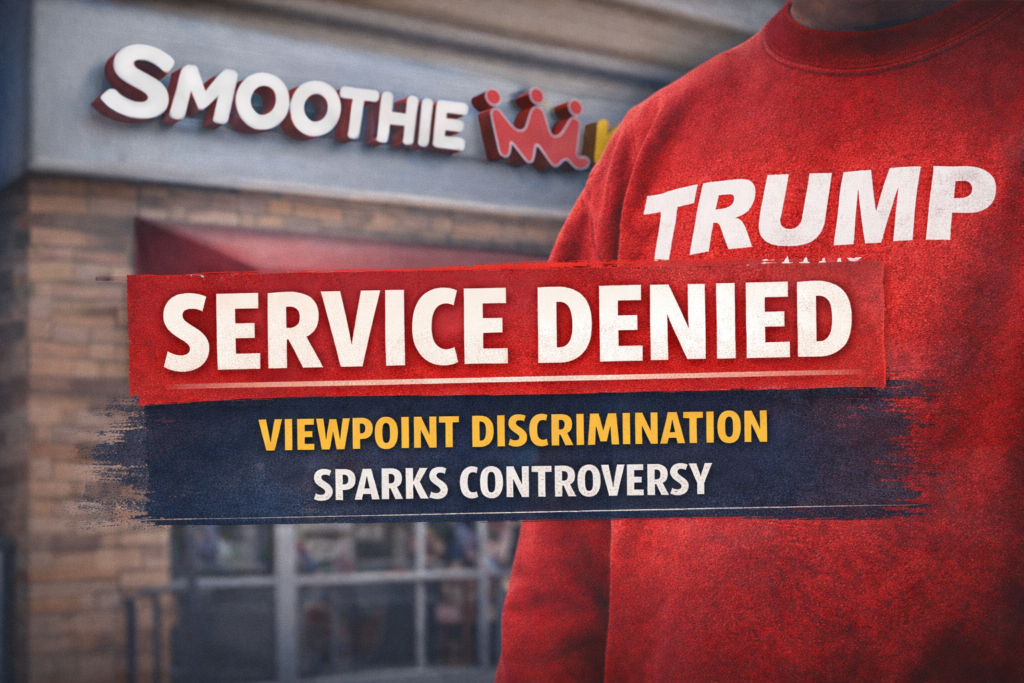
Summary: Smoothie King Employee Made Service Conditional Over Partisan Ideology A recent incident at a Smoothie King franchise in Michigan has drawn significant attention online. But beyond the viral video and predictable partisan reactions, the in-person debacle raises a broader cultural question that deserves careful consideration. According to footage circulated on social media, a couple entered the Ann Arbor location and the husband was wearing a sweatshirt that openly supports President Trump. Employees reportedly objected to the supportive, non-vulgar message on the sweatshirt and refused service. One employee, identified later online from the video as Janiyah Williams, told the man, “we don’t support that [sweatshirt], our company is not about that, we’re not really comfortable with that.” After the customer responded, she added, “Ok well then you can have a good day because we have the right to refuse service.” The couple asserted that she was discriminating against them as customers and said they would leave. When he asked for her name, she replied, “we’re not serving Trump supporters. Have a good day.” Another employee in the video can be heard saying, “Trump discriminates against us,” to which the couple responded, “What does that have anything to do with us wanting a smoothie?” Williams then said, “supporting Trump is embarrassing,” and reiterated, “we have the right to refuse service here and that’s what we did.” At no point in the video was the couple demonstrating any threatening behavior, harassment, or disruption. The refusal appears to have been based on the disagreement with the acceptable political viewpoint expressed by the customer. That decision — not the customer’s conduct — appears to have sparked this entire controversy. In the aftermath of the viral moment, a GoFundMe page titled, “Support for Safety After Online Harassment” was launched by the employee with a description image that stated, “teen filmed without consent faces online threats’ funds will secure safety, legal aid.” The fundraiser portrays the employee as a victim of backlash stemming from the viral footage. No one should face threats. Harassment and intimidation are wrong. Full stop. But it is equally important to acknowledge that the public reaction did not emerge out of thin air. The controversy began when an employee, while on duty and representing a national brand, made an explicit ideological determination that “we’re not serving Trump supporters” upon seeing a paying customers sweatshirt. Smoothie King’s Stated Values Smoothie King publicly promotes corporate principles such as: “Do the Right Thing” “We Are Better Together” A commitment to serving and strengthening communities These are admirable values — they reflect the kind of stability and community-minded posture most Americans expect from national brands. However, the reported actions at the Ann Arbor franchise appear difficult to reconcile with those very commitments. If “doing the right thing” includes fair and consistent treatment of customers, then refusing service over lawful political expression strains that promise. If being “better together” reflects a belief that communities function best when citizens of differing views share common spaces peacefully, then excluding someone solely over appropriate political apparel undermines that principle. Corporate values are not meaningful if they apply only when convenient. The values of any company only carry weight when applied consistently — even when disagreement may become present. Conduct vs. Viewpoint Businesses have every right to maintain order. If a customer is disruptive, aggressive, or interfering with operations, management can and should respond. Civil standards require it. But quiet expression, such as wearing a shirt with a political message is far different from misconduct. When service is denied, not because of behavior, but because of viewpoint, the standard shifts from enforcing rules to enforcing ideological preferences. That shift may seem small in a single incident, but culturally it is significant. If the operative question becomes, “Do we agree with what you believe?” rather than “Are you behaving appropriately?” then everyday commerce begins to take on a new character — one shaped by ideological approval rather than neutral standards. The Cultural Norm That Is at Risk The First Amendment restrains government power, not private businesses. That legal line is clear. But a free society depends on more than constitutional text; it depends on shared cultural norms. For generations, Americans have understood that ordinary commerce operates as neutral ground. Citizens with deeply different political views could walk into the same store, order food at the same counter, and conduct business without being subjected to an ideological test. That norm has been a quiet stabilizing force in American life. When a business signals that service may hinge on political agreement, that norm begins to erode. And erosion rarely happens all at once, rather it happens incrementally, incident by incident, until what was once unthinkable becomes routine. The long-term consequences are not abstract: Customers begin to conceal their views to avoid conflict. Employees feel empowered to act as arbiters of acceptable opinion. Businesses become extensions of political confrontation. Communities retreat further into ideological enclaves. That trajectory does not strengthen civic life — it weakens it. Equal Standards Protect Everyone The New Tolerance Campaign does not evaluate this situation based on the specific political message involved. The principle is either neutral or it is not. If a customer wearing progressive advocacy apparel were denied service solely because employees objected to the message, the concern would be the same. If a conservative customer were refused service for a lawful slogan, the standard would not change. Equal standards must apply regardless of personal viewpoint. Once a society accepts that lawful beliefs can justify exclusion from routine commerce, the protection becomes unstable. The precedent established against one viewpoint today can be applied against another tomorrow. Neutral standards protect everyone. Selective standards protect no one for long. An Opportunity for Leadership The incident in Ann Arbor presents an opportunity for Smoothie King leadership and franchise ownership to clarify their policies and reaffirm their principles. There is a straightforward path forward: Clarify that service standards are based on conduct, not viewpoint. Distinguish clearly between disruptive behavior and lawful expression.